|
 |
before


コミュニティ スクール ソトノノノ
自然を学ぶ学校をつくる
太平洋に面する熊野市の市街地に、コミュニティスクール「ソトノノノ」をつくった。
JR熊野市駅から徒歩10分という市街地の立地でありながら、前面には海、背後には山が迫る熊野らしい地形ゆえに、
急峻な崖地の中腹が敷地であった。そこに、朽ち果てるようにひっそりと大正期の小さな古民家が建っていた。
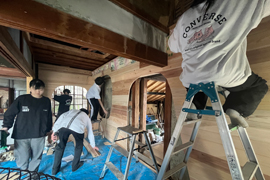
それを地元工務店と大学生たちとでリノベーションした。
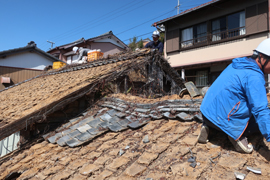
その建物は、外壁も屋内も蔦が覆い、屋根には穴が空き、瓦は崩れ落ちて軒先にぶら下がる。
床は抜け、柱や梁は腐朽してスカスカになっていた。
しかし調査を進めると、正方形平面の母屋には、立派な梁組と高い天井が残り、
かつて格調高く建てられた痕跡が確かに息づいていた。
一方、後年に増築された棟は安普請でつくられた粗末な小屋のようであった。
また母屋では床下の痛みが激しく、増築棟では屋根と梁の損傷が特に激しかったこともわかった。
この古民家の所有者であり、「ソトノノノ」の運営者は、東京と熊野を往復する40代のニューヨーカー。
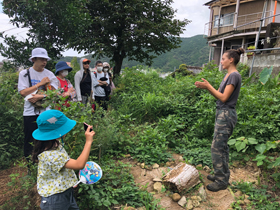
彼と仲間たちが思い描くのは、自然を教科書とし、自然の中で暮らす知識とスキルを学ぶための学校である。
敷地は、隣家やアパートの前を通らないと辿り着けない“無接道敷地”。
軽自動車が入るのも難しい細い路地のさらに奥にある。
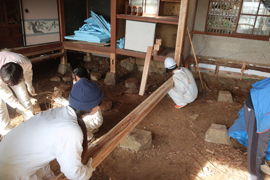
解体から仕上げまで、廃材も資材もすべて手運び。古民家と軽トラの間を、何度も往復した。
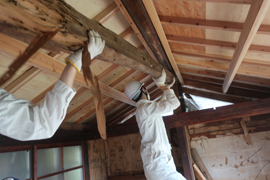
母屋はコミュニティスクールとして利用するため、床下・壁・屋根に断熱を施した。
特に強い日差しを受ける屋根と、崖から吹き下ろす冷風が通る床下は手厚く断熱している。
天井が破れていた部分は形を整え、あえて開口として残した。見上げると、
修復された梁組が空へ向かって伸び、かつての力強さをそのまま体感できる。
増築棟にはシャワー、トイレ、キッチンなどの水回りを配置した。
梁が低い増築棟にユニットシャワーを納めるため、
一部床を切り欠いて土間を打ち、地面に寄り添うような配置とした。
母屋は空へと開かれ、増築棟は大地と呼応する、そんな建築となった。
リノベーションに使った木材の多くは、地元製材所の協力で熊野産のスギとヒノキを使用した。
内装の床や壁には、製品検査を通らなかった“ハネ材”を集めて利用している。
そのため樹種も幅も異なる板が混ざり合い、
リノベーションならでは渾然一体となったパッチワークのような表情が生み出された。
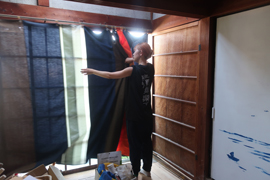
さらに、大学のアパレル系研究室からは不要になった着物の反物を譲り受け、学生たちがミシンで縫い上げてカーテンに仕立てた。
古くなっていた既存のカーテンは撤去し、その新しい反物カーテンを海側のガラス戸の前に吊るした。
カーテンを開ければ街と太平洋の風景が眺められ、閉じると室内に反物の柄が装飾として室内を彩る。
地元の人、企業、木材。地域のあらゆるリソースとともにつくりあげた、ささやかだが確かな建築。
ここから、熊野の自然を教科書とした授業が始まっていく。
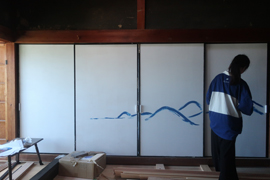
工事の仕上げに、修復した襖に熊野の風景を描いた。
自然のなかに人々の生活が息づいていることを表す絵でもある。
――「ソトノノノ」は、そんな自然の中に建ち、静かに動き始めている。
community school "sotononono"
In the coastal city of Kumano, facing the vast Pacific,
we created a small community school called Sotononono.
Although the site lies only a ten-minute walk from JR Kumano-shi Station,
the terrain here is distinctly Kumano: the sea unfolding in front,
the mountains pressing in from behind. The school sits halfway up a steep slope,
where a small Taish?-era farmhouse had been quietly decaying for decades.
Together with a local construction firm and university students from Kansai, we set out to renovate this old house.
The building had been overtaken by ivy both inside and out. Holes opened in the roof,
broken tiles hung from the eaves, the floor had collapsed, and many of the columns and beams had deteriorated into hollow shells.
Yet as we surveyed further, we discovered that the original square-plan moya still retained
its impressive timber structure and generous ceiling height
―a trace of the dignity with which it had once been built.
In contrast, the later extension was crudely constructed and severely damaged, especially in its roof and beams.
The owner of the farmhouse, and now the operator of Sotononono,
is a New Yorker in his forties who moves between Tokyo and Kumano.
He and his colleagues envisioned a school where one learns from nature itself
―acquiring the knowledge and skills needed to live within it.
The site is a non-frontage lot, accessible only by passing in front of neighboring houses and apartments.
Even a small car would struggle to reach it, tucked further behind a narrow alley.
From demolition to final finishing, every piece of waste, every tool,
and every new material had to be carried by hand.
We walked back and forth between the house and the truck countless times.
To adapt the main house for use as a community school, we insulated the floors, walls, and roof.
Extra attention was given to the roof, exposed to intense summer sunlight,
and to the floor, chilled by winds descending from the cliff.
A portion of the damaged ceiling was reshaped and intentionally left open.
Looking up, visitors can now feel the full force of the restored timber structure stretching toward the sky.
The extension houses the water facilities
―showers, toilets, and a kitchen. Because its beams sit unusually low,
we carved out part of the floor and poured a small earthen slab, setting the shower unit slightly deeper in the ground.
If the main house opens upward to the sky, the extension responds downward to the earth.
Much of the timber used in the renovation came from local sawmills:
Japanese cedar and cypress grown in Kumano. For the interior floors and walls,
we gathered “rejected” boards that had failed product inspection.
Varied in species and width, these pieces come together to create a surface with a singular richness and character.
Built with local people, local companies, and local wood,
Sotononono is a modest yet grounded piece of architecture.
From here, classes will begin―using the landscape and nature of Kumano as their living textbook.
When construction was complete, everyone standing on site felt the same quiet certainty:
this place would take root in the community and grow toward the future.
As the final touch, we painted scenes of Kumano onto the newly repaired sliding doors
―images that show daily life woven gently into the natural world.
Sotononono now stands quietly within that same landscape, ready to welcome its next chapter.
|
